All Categories
Featured

Emergency Tree Services for Southern California Campuses
Table of Contents
Slowly mound soil approximately top of root ball and place earthen ring around edge of root ball. Add mulch 2 - 3" on ring, but only 1/2" on top of root ball or none at all. Never ever pile mulch up around trunk of tree. Leave a 10 inch radius from trunk of tree.
Bark mulch shall be 2 - 3" deep throughout. Mulch ought to be raked flat and even - no stacks or swellings. Rock locations will consist of a landscape fabric. 1:11 Cornell Structural Soil Mix shall be made use of under all difficult surface areas where trees are to be planted in tree wells surrounded by concrete, pavers, or asphalt.
Then type "Outreach > Structural Soil" in the Search Box at the top. 1:12 Tree ball and burlap root ball diameter shall be 12" for each 1" of trunk diameter. 1:13 Ought to there be a discrepancy between the American Association of Nurserymen Standards and UNR Standards, UNR standards shall prevail. 1:14 The contractor will alert owners representative to authorize plant placement before the planting of all trees, shrubs, & turf.
How Smart Canopy Management Mitigates Campus Risk
1:16 Trees that have actually been grown tied straight to stakes will not be accepted. 1:17 Trees and shrubs stored on site will have their containers or root balls safeguarded from direct sun light by professional. For balled and burlap (B & B) trees, heel in and cover with mulch as much as top of root ball.
1:18 Trees and shrubs kept on website will be watered regularly to keep consistent wetness, daily if essential. Change per weather conditions. 1:19 Do not install plants when the ground is frozen. 1:20 Install plant material plumb and in the center of pit slightly above surrounding grade. 1:21 Do not prune any plant material without authorization from owner's representative.
1:23 Container plants with densely swirling rigid roots inside the container surface will not be accepted. 1:26 There will be a pre-construction conference with owner's agent before building and construction starts.
Commercial Tree ServicesExceptions enabled just with approval of owner. Existing trees shall be preserved where Tree stacking approach to be reviewed with Owner. Specialist to send landscape defense and watering plan, and schedule to Landscape design shall minimize water use and Water conserving native plant materials will be utilized to the best level Grading, dust control, weed control, curbs, seamless gutters, streets, off-street parking and sidewalks will comply with local regulations and regional style and site building and construction requirements.
Implementing Smart Landscape Conservation in California
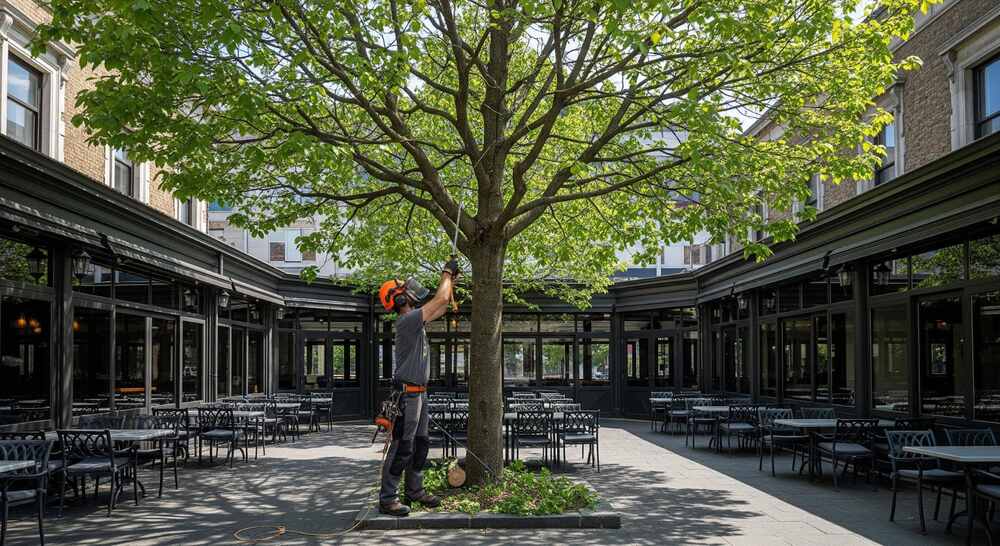
(describe ANSI 300 standards) Thinning: The canopy of a tree periodically ends up being so thick that the canopy needs to be thinned. Thinning is the elimination of lateral branches at their point of origin or the reducing of a branch or stem by cutting a lateral large sufficient to presume the terminal function.
Trees might require to be thinned to reduce storm damage of to permit better air circulation to lower illness problems. Trees might be thinned as a bird control procedure to produce a less desirable roosting site. More typically, trees are generally thinned to permit extra light to reach plants growing underneath the canopy.
There are numerous reasons for raising the crown of a tree. Unblocked visibility is essential to improve the security and security of the campus. Along streets and parking lots, it is imperative that the trees have the appropriate clearance of 14 ft. 6in. for automobile traffic. Pedestrian sidewalks will not exceed 7 ft.
Deadwooding: Throughout the life of a tree, it is a normal process for some branches in the canopy to die while brand-new branches are being produced. Other branches die due to the affect of illness of other stress elements. In a managed urban forest, trees occasionally require to crown cleaning to get rid of dead, unhealthy and passing away branches.
Optimizing Medical Canopies for 2026
This is particularly important for nonessential larger than four inches, which might trigger serious injury to people and property. Elimination: Like all life on earth, trees ultimately decline and die. Research studies have actually shown that due to the multiple tensions that exist in the metropolitan environment, trees have a significantly minimized life span.
There are two main reasons for eliminating a tree: visual appeals and safety. When a tree declines into poor condition, it has actually exceeded its beneficial life and needs to be gotten rid of so that it can be replaced with an energetic healthy tree. In a lot of cases, a tree, despite visual look, poses a risk to people and residential or commercial property and should be eliminated.
These trees require to be pruned or shaped to direct future development. The outcome of this kind of pruning is a more gorgeous and structurally sound tree and a considerable decrease in future maintenance expenses. Cabling/bracing: Cabling and bracing is the art and science of using cables and/or wood screws (braces) to fix or lengthen the usefulness of a tree.
Braces are typically used in combination with cable televisions to help support of pull split trunks back together. Cabling and bracing need to not be utilized to remedy harmful tree issues, however they can be beneficial in extending the life of a substantial tree. Cavity filling: Trees suffer mechanical damage from a number of sources including landscape upkeep devices, automobiles, the environment and other aspects.
Improving Campus Landscape Resilience Through Advanced Tech
Cavities can be hidden within the trunk, or they can be exposed to the surface leaving a little or large open hole. It becomes difficult or difficult for the tree to grow throughout the expanse and fix the damage, so it in some cases becomes needed to fill the cavity so that callus can grow throughout the hole and block the cavity to the outside.
Stumps detract from the aesthetic appearance of the school and can develop safety dangers. Fertilizing: Continual elimination of leaf particles around a tree eventually results in a loss of valuable nutrients that would normally be available to a tree in a natural forest.
This usually involves injecting a soluble, slow-release fertilizer into the soil so that it can be used up by the root system. Mulching around the trees is also crucial for returning nutrients to the soil. Spraying: Occasionally, trees are assaulted by numerous insects and bacteria and should be treated to secure them from illness.
Comparing New or Old Water Management
Soil modifying: Biostimulants and Mycorrhizal fungis are included into the soil profile near the root system of the tree to enhance health and vigor. The University prioritizes water-conserving landscape design that requires minimal upkeep. Since the University school is a designated arboretum, it includes a variety of plants, including non-native species and drought-intolerant varieties.
The university arboretum consists of edible plants such as fruit trees, berry bushes, and herbs as ornamentals, however they were not planted for use as a food source, and brand-new edible plants are not being contributed to the landscaping. Harmful plants are not used near water, dining facilities, and children's centers.

Latest Posts
Smart Irrigation Systems for Commercial Resilience

Reliable Tree Services for Southern California Hubs
Advanced Watering Systems for Commercial Safety